Thursday, June 22, 2017

Are Your Students College Ready?


Challenge 1:

Learn more about the SAT/PSAT and ACT. Go to the CollegeBoard website and the ACT website and browse. See what those tests are like. Do you know what topics are covered on those tests? Learn the importance of the PSAT…it’s more than just practice! Do  you know the purpose of the ACCUPLACER (or if you are from Texas it’s called the TSI)? The more you know about these tests, the better you will understand how you can help prepare your students.

Challenge 2:

If you teach 5th grade math, does it matter if you know what is on the math portion of the SAT? I challenge ALL math teachers (elementary, middle school and high school) to take the math portion of the SAT or ACT. If you do not teach math, I challenge you to pick any of the portions of the SAT or ACT and take them…especially if it’s been awhile since you graduated from college! If you are a science teacher, check out the ACT science test. WOW! It’s crazy all the reading involved on that test! Open your eyes to what is on these tests and how they ask questions.
slide1

Challenge 3

Implement one thing (a topic, a strategy, a visual) that will help your students be successful on college entrance exams. Here are some examples:
1)Pick a topic to focus on and spiral into your lessons every so often.
2)We all have important vocabulary that we cover, but Google SAT vocabulary list and create a word wall with some of these words.
3)Pick a testing strategy like timing your tests.
4)If you teach math, have calculator and non-calculator portions of your tests.
5) Use actual SAT or ACT or ACCUPLACER questions as bell-ringers. If you teach younger grades, simplify them slightly if needed.
6) Show your students how to get on Khan Academy. This site is awesome and has great college entrance practice.

Challenge 4

Talk about these tests in class. Start talking about them while the students are young so they know what’s coming and know what to expect. The great thing about this topic is you are starting the conversation about going to college. Some students do not get to have that conversation at home, so the only place they might hear it is from you.

Challenge 5

If you teach 9 – 11th graders, encourage your students to go ahead and take the ACCUPLACER or the equivalent in your state. It doesn’t cost much and they can take it as many times as they like. Have them bring the paperwork back to you and you can help them figure out their strengths and weaknesses. In Texas, the students must make a certain grade on the three parts so they do not have to take remedial college math and English classes. My next door neighbor took her 8th grade daughter up to the nearest community college last year and had her take the test. Guess what? She passed all three portions and she hasn’t even taken high school Algebra yet. My school encourages students to take the test when they are ninth graders. Many of them pass the first time, but most do not. This is when I step in and start reviewing them for the next time they take it.
I’ll have to admit, that I did not see the importance of learning as much as I could about these tests until last year. I was given a class full of seniors that had not passed the TSI yet and my job was to help them pass it before the end of the semester. I found very little help online when it came to work that I could give them. I had no choice but to create my own reviews. I had to research the topics and I came up with 7 packets. I offer these in my TpT store. I also bundled all 7 reviews. My son is a senior, so I decided to put his picture on the front of the packet. I have to brag on him, he passed the TSI with flying colors. He is a fast test taker. It only took him an hour and five minutes to take all three portions. It’s an interesting test. If you do not pass the first 2o questions or so, it gives you 4o more to do, so that’s why it takes some students forever to take it.


tsi-bundle
College Ready Bundle

After most of the students in my class had passed the TSI, I couldn’t let them come to class everyday and do nothing, so I started reviewing for the SAT and ACT. Again, I created my own material. I’m glad I did because now I know so much more about those tests. I plan on making more SAT reviews when I get a chance. I have bundles and individual products. The bundles are seen here:



sat
SAT Bundle
act
ACT Bundle

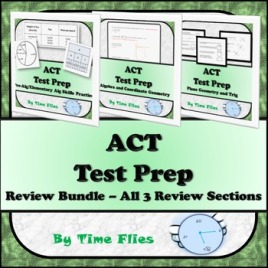
I basically had to write my own curriculum for a semester. That’s not easy when you are also teaching Algebra II and Pre-Cal. If you are in the same boat and need curriculum for a senior math class, then I’ve bundled all three entrance exam reviews into a MEGA bundle as seen below:


bundle-of-3
MEGA Bundle

Please take this advice and start familiarizing yourself with these very important tests. See if you can add anything to your routine that might help your students. Be creative in your implementation and don’t reinvent the wheel. I hope I have motivated you to start your “College Ready Research.” Encourage your colleagues to do the same. Send me some of your ideas if you get a chance. Good Luck!

Thursday, May 4, 2017

5 Ways to Gain Control of Your Classroom!


At certain times of the year, you may feel like you've lost control of your classes. Toward the end of the year, you've become lax and the kids are getting too comfortable. Students are talking while you're teaching. You have a hard time getting their attention. Phones are visible along with earbuds inserted. You are miserable and little worried about how you are going to make it through the rest of the year. I have 5 easy things to try to get you and your students back on track. You will realize how easy these things are to do and wonder why you haven't done them all along. Sometimes even teachers lose focus and go into survival mode. Survival mode is a hard place to stay. Try these 5 things and I promise you will be happy and you can finish the school year with a confident attitude.
I. A seating chart is a must!

It doesn't matter what grade you teach. Seniors? Juniors? 7th Grade? Doesn't Matter! You need a seating chart if you've lost control. Look at the seating arrangement of each class. Have they started sitting where they want to sit? Are they too comfortable with the students around them? Do you have them in groups? Have you ever had them in a seating chart? 

My suggestion is to put your classes in rows for a while and decide where you want each student to sit. Who needs to be in the front? Who can sit in back? Who does not need to be by each other? Strategize! The kids will moan and groan, but ignore it because you're going to see good results from this seating chart. You'll probably have a few kids come up to you and say that they can't see from their new seat or they can't sit by a certain person. You will hear some excuses, no doubt. For right now, just tell them to sit where you put them. (You are in charge!) If you see a problem with where some kids are sitting, YOU DECIDE when to move them!

II. Getting Their Attention!

Now that they are in their new seats, it's time for a discussion. You are going to explain that they will not have their phones out, unless they have permission. You do not want to see the phones or see the earbuds or you will take them up and either turn them into the office or not give them back until the end of class. Now, if you say this, you have to follow through. The first person that messes up needs to be made an example. This will get the attention of everyone. Don't budge on this!

The other thing you are going to tell them is that since you've had problems getting their attention lately, you will put your hand up when you need their attention. When they see your hand up, they put their hands up too until everyone has their hand up and mouth's shut! (Seniors can do this! Adults can do this! Kids can do this!) Tell them that you will not talk over them and until they are quiet, you will stand and wait. If they choose not to listen, then you will hold the class after the bell. (Yes you can do this. You don't have to hold them long. 30 seconds to a minute will get your point across.) 

III. Walk the Class!

From this day forward, you need to walk the class. Don't stand in front of the room and teach. Be everywhere. Talk to the class, then walk around and see if they are doing what you asked them to do. You can teach from any part of your classroom. Let students go up to the board. You don't have to always do it. If you've never walked your class, you will be amazed at how this will change your classroom. Try to talk to each student at some point during the class period. Don't hover over any student for long though. Keep moving and act like you are really checking out what they are doing. If you really want to put on a good show, get a clipboard and act like you are writing stuff down that you see. You can even walk around and put stars, stickers or check marks on things that you see that are good! You will have fun and the kids will too. All kids like stickers, smiley faces and check marks! 

IV. Calling Cards!

Another awesome trick to keep your students on their toes is to randomly call on people to answer questions. There are random selectors on the internet, but I like to use index cards. It's very easy to do. Put each student's name on an index card. Shuffle the cards and randomly select students to answer questions. When I'm having kids work an example problem, I'll warn them and say, "I'm going to randomly call on someone in a minute." If you call on a kid that sits and looks at you because they don't know the answer, still make them give you something. You can give hints, or help them out, but don't let them get away without answering the question. All the students are watching to see how you handle the kid that says, "I don't know." This will get your students engaged, because they don't want to be the kid that doesn't have an answer. If students give me wrong answers, I still praise them. I don't want anyone to be afraid to answer a question because they are afraid of being wrong!

V. When it's Time to Go!

Be in charge...even when the bell rings. Did you know that the bell doesn't release the kids? YOU DO! I tell the kids that they are not allowed to leave the room, until they hear me say, "Have a nice day!" I keep them in their seats until I inspect the room. Is there trash on the floor? Did they put up any materials they used? One trick, I've learned to do and yes it works with any age, five minutes before the bell I say, "I'm inspecting the room and the cleanest, quietest, straightest row will get to leave first." This works great on that rowdy class that always leaves your room in a mess. I usually walk around and point out trash on the floor and other things that need to be corrected. When the bell rings, I'll pick one row to go. I don't release another row until the first one is gone. When I'm down to 2 or 3 rows left, I usually say, "Ok, everyone can go now." If you do this a few times, they respond well. If there's one kid talking and keeping their row from leaving, I'll say that everyone can leave, but "Johnny." I'll let everyone go and Johnny stays behind. It's entertaining to say the least, but I promise it makes a difference.

Don't be miserable, take charge. It's never too late. Trust me, I've made every mistake possible. I've learned that being FIRM is the key. I left many days, almost crying because my day has gone terrible, but it was my fault. Take control. Kids will respond as long as they see you are firm and fair. I hope the rest of your year goes well. If you would like a complete discipline plan for secondary students, see the link below.


5 Ways to Gain Control of Your Classroom!

Patty paper has so many uses. One of the very first lessons in Geometry is a reminder of the different types of angles along with the defi...